The Direct and Indirect Effects Model of Reading (DIER) – Young-Suk Kim
In a fascinating presentation, Professor Kim explored the hierarchical relationships that are presented in the DIER model of reading. This is helpful for educators. In contrast to the Simple View of Reading, which is a static model, the DIER explores how different aspects of the complex reading process work together and provide insight into the order we might introduce children to different skills. It helps us understand what to teach first and then next. As she says, predictors become mediators and then finally outcomes – in a temporal sequence. The DIER suggests that at present, the order in which we are encouraged to teach different aspects of the reading process at the moment is not reflective of the research.
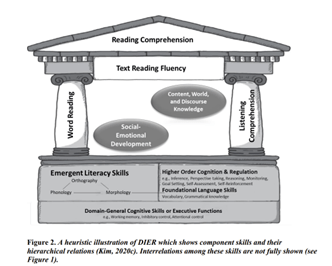
Image taken from Kim, Young-Suk. (2023). Simplicity Meets Complexity: Expanding the Simple View of Reading With the Direct and Indirect Effects Model of Reading (DIER).
This house representation of the model helps to explain more clearly. It is easy to see what the foundations of reading acquisition are.
We teach phonological awareness because it supports word reading – it is the foundation and therefore needs to come first.
We need to teach higher order comprehension skills, such as inferencing, reasoning and self-monitoring in the early years because it supports language comprehension and is needed to support language development. And therefore reading comprehension.
The findings of the most recent studies testing the hypotheses inherent in the DIER suggest that over and above word reading and listening comprehension, text reading fluency does not directly contribute to reading comprehension outcomes. In contrast, as children get older, comprehension processes play an increasing role in text reading fluency – and therefore word reading and language comprehension become more integrated.
So, it is interesting to reflect on the implications of this model… how might we structure the teaching of reading to ensure we support all children? Phonological awareness (in all its glory) and morphology certainly seem important – as well as orthography (taught initially through phonics). The higher order skills that underpin language comprehension are also essential. Thinking and reasoning about the texts they are reading seems to be a crucial aspect of the process.
Do we do both? From the beginning?
References
 Megan Jane Dixon: teacher, Researcher, Leader