Identifying the active ingredients of the effective teaching of reading comprehension is fraught with challenges. In 2000, the National Reading Panel (U.S.) concluded that teaching reading comprehension strategies was one of the five essential ingredients of reading instruction (in addition to phonemic awareness, phonics, fluency and vocabulary). However, the reliability of these findings cannot be considered strong as the most appropriate method of synthesising the findings of across the studies collated, namely meta-analysis and systematic review, was not considered possible. The expert review panel suggested that the studies available used widely varying methodologies, measures and implementations which precluded a meta-analytic approach (National Reading Panel (U.S.), 2000).
Several years later, Elleman et al. (2009) echoed these limitations, whilst attempting to summarise the effects of specific vocabulary instructional techniques in the context of the development of reading comprehension. A lack of reporting for measure reliability, treatment fidelity and training of the intervention implementers across the studies means that any results reported cannot be ascribed to the intervention practices studied (Elleman et al., 2009).
There are a dizzying range of programmes and schemes that have been studied, each combining different strategies and approaches: Collaborative Strategic Reading, Transactional Strategies Instruction, Peer-Assisted Learning Strategies, Concept-Oriented Reading Instruction, Reciprocal Teaching. Yet, it is unclear which individual aspects of each programme can be considered active ingredients (Embry & Biglan, 2008). Many studies focus on improving outcomes for small, targeted groups of students, who have been identified with reading difficulties or special educational needs. Typically, the interventions described are delivered by the researchers themselves, or research assistants. Few studies are concerned with whole class or large group teaching, delivered in within normal school context, by class teachers. Finally, many studies refer to Multi-Component Interventions (MCI), from which it is challenging to isolate the individual effects of the differing aspects of the intervention. Nevertheless, it is possible to identify some high-level guiding principles.
For students who lack word reading skills, in line with the Simple View of Reading (Gough & Tunmer,1986) it is necessary to build these word-level skills while teaching comprehension (Boardman et al., 2008; Scammacca et al., 2007). The Language and Arts Reading Research Consortium (LARRC) (2017) suggests the comprehension of spoken language will constrain reading comprehension. Some researchers suggest that once a level of word decoding mastery has been achieved, a focus on language comprehension is desirable (Clarke et al., 2010; Duff et al., 2011). Alternatively, reading to early readers can help them learn to make sense of text (Swanson et al., 2011; Wright et al., 2022). Studies of fluency indicates that increased reading rate and accuracy do not always result in improved comprehension (Wexler et al., 2008).
In line with Ellis and Smith’s (2017) conceptualisation of an environment supportive of early reading acquisition, Pianta et al. (2008) suggest that a warm, emotional quality to the teaching is essential in combination with tailored one-to-one interactions, high-quality feedback that prompts conceptual development, time on task, and interesting and challenging tasks rather than worksheets.
There are several overarching principles about how teachers influence the environment in their classrooms. Firstly, limited training opportunities for teachers do not seem to be enough to change their habits in the classroom. Secondly, neither purely strategy or purely content focused methods are uniquely effective and thirdly, a blend of both content focused, and strategy focused approaches might not be enough to support the development of the warm, emotionally responsive climate that is thought to be beneficial. It seems both minds and hearts are required.
This is the start of my thinking about school development – or school improvement. I am sharing eight principles that I have come to work from. I find it helpful to share these with colleagues, regularly- they underpin why I might do and say things and how I come to suggestions and decisions. They are my ground rules for working in what is often difficult and challenging circumstances. I have written about the first four principles in the first part of this blog. In this section, I present the final four principles in no particular order.
5. Unkindness is not my style. Blame does not really help. We are looking for ways forward, but it is important to understand what might have happened, so we can avoid it. I ask questions, a lot of them.
I will never understand why some leaders feel being unkind is a sign of strength. I have seen leaders shout, demean and belittle staff. I’ve been asked to write unfavourable lesson observation notes because a leader wants to put a teacher on an action plan. I have seen leaders resort to incredibly Machiavellian ways, scheming and plotting to save their own skins and discredit someone they feel is a threat. Of course, I am not talking about momentary lapses of control under stress. I am talking about a style of working with people that is intended to be a show of power and control. I have written about this in detail in Part 2 of this blog. It seems to be a disease infecting swathes of the education sector, including those who sit at policy tables and many who work in school improvement.
To me, this way of working is counterproductive. Principle 3 mentions that I feel trust between colleagues is incredibly important, and that extends to trust in behaviour. All staff who work in schools should be treated with kind respect and should expect to be treated well. Ofsted – take note – the behaviour of your inspectors is simply not OK.
So, I make it clear to anyone I work with that I do not believe in being unkind and I am not getting involved in any games. I believe in working together. But I do ask lots of questions – that is just my way.
6. Using research helps us make decisions. Using research is extremely important. It is not an easy way out – we need to be careful about the studies we look at and be professionally sceptical, but having a research paper to refer to can help take away the personal heat and opinions from difficult situations. We can use the research to justify our decisions and actions (or even lack of action), to give us ideas for the way forward, and even to decide to stop doing something. But research is only ever there to suggest what might help. It describes the past, not the possible future and we must always be tentative.
7. Using a research-ly process can help us make everything clear and transparent for everyone.
In most of the schools I have worked in, they have already tried everything there is. Because they are in a pickle, everyone has come along and told them to do something different, because it worked at *fill in name of school/trust/country*. The school leaders have dutifully adopted every new strategy suggested and watched them fail. Because a school in a pickle is a unique place and unique places usually need a unique, idiosyncratic approach – or a mix of approaches. Using a researcherly process helps with this. It is a cycle of action that can move quickly or slowly. You could use the cycle across a day, or a term. The process helps structure the thinking and the action around school improvement, allowing everyone to take back some control and be measured and strategic about what is happening. It stops the panic and in many cases, saves a fragile budget from panic spending. The process also helps involve everyone in the school and ensures all voices are valued.
The process starts with finding out what is happening. We might walk around the school, do some assessments, analyse some data (could be assessment data, attendance, behavioural reports, examples of children’s work, or interviews with children, staff and parents or more), talk to some children and staff. We might watch what happens in lessons, or in the playground. We spend time observing and thinking. We are not making judgements. We are trying to understand. Exploring all this data helps us ask questions about what is happening. Sometimes, these questions will be uncomfortable – but that’s OK. We ask questions about helping the children to thrive, for example “What helps all children in KS2 learn to read?” Or “Which pedagogies support children in KS1 to be able to use number bonds comfortably?” or “How can we improve spelling in Year 5 and 6?” These are not perfect questions – they are not meant to be. They are there to ensure we are targeted and focused on the things that matter the most at the time.
Next we try and find answers to the questions. We think about the research we have, what we have done in previous schools and what might help us answer our questions. Once we have some ideas that we want to try, we start to think about how to introduce this into the school. We do a lot of thinking and a lot of dreaming. We think about what will happen when implement the new idea; we dream about what we will see if it works and how we will know it is working. We also dream about what might go wrong. We think through how we will know it is not working and what we will need to do if we do not see the green shoots of change we dream about. We make sure we understand what the signs of failure could be. Then we think through all the practical logistics -who, what, when, where, for how long, what will be needed. Once all of this is done, then we can start piloting the new idea.
To pilot the idea, we ask a couple of people to work with us and trial the new idea. We work closely with them, making sure they can ask all the questions they want. We share everything with them and we watch carefully. Once we know it is working and having an impact, we share the ideas more widely across the school. The teachers who have piloted the ideas become the experts in the new idea. They work with their colleagues to implement the new idea in their classrooms. If it doesn’t work, or there is a big hitch, we stop, thankful that we discovered the problem at this early stage. We share the failure with everyone, because we do not want that to happen again. We go back again and identify another direction and begin the process again. Pilot, refine, share, pilot, refine, share. We are never over-confident it will work, but we are confident that it may have an impact (because we have read the research). We are always tentative and open to failure. We know we are swimming in uncharted waters and are alert to possible difficulties, ready to intervene swiftly, if needed. We keep going because the children deserve the best and we do not know what the best looks like, yet.
The aim is to build capacity and capability in everyone – we are not finished until everyone can do it by themselves.
My last final principle was told to me by a very wise, and kind colleague I worked with at the beginning of my career in school improvement. Never, she said, leave a school in a worse place than you found it. She believed in planning an exit strategy as soon as you walked through the door and ensuring we left behind colleagues who were ready and prepared to carry on what you we started.
Much of the school improvement work happens once you have been and gone and you must leave the school ready to carry on getting better and stronger. This means working strategically to build skills and knowledge in all – not just fixing things. You are not a hero. Although you may have helped to quench the flames of a full-scale school emergency, the teachers on the ground are the ones who will be rebuilding.
This is the start of my thinking about school development – or school improvement. I suspect it there will be many smaller pieces to make up this whole part, that may, or may not follow an order. It is likely, like the process of working in schools, to be messy and complicated. It is only when you get off the dance floor and stand on the balcony evaluating what you see that you get a sense of how far long the journey you have gone, what is working and what would benefit from an additional tangent.
But, in this first small piece, I want to consider some of the principles that I have come to work from. I find it helpful to share these with colleagues, regularly- they underpin why I might do and say things and how I come to suggestions and decisions. They are my ground rules for working in what is often difficult and challenging circumstances. I present them in no particular order- the importance will vary from school to school and situation to situation.
School improvement and school development are not the same – we need to decide where you are.
If you carry on doing what you have always done, you will always get the same thing. Change must happen, no matter how uncomfortable that it
Working together, in collaboration – you are the experts in your school.
At some point, I will say something or do something that you will not like. It is never my intention to do this. I am here to help and if I am not being helpful, then there is no point in us working together. Please let me know if I am not being helpful.
Unkindness is not my style. Blame does not really help. We are looking for ways forward, but it is important to understand what might have happened, so we can avoid it. I ask questions, a lot of them.
Using research to help us make decisions. It can help takes away the personal heat and opinions from difficult situations. But research is only ever there to suggest what might help. It describes the past, not the possible future.
Using a research-ly process can help us make everything clear and transparent for everyone.
The aim is to build capacity and capability in everyone – we are not finished until everyone can do it by themselves.
Let’s consider each of these principles a little further.
School development or school improvement – which place are you in?
Over the 25 years of my career, I have rarely been that confident that Ofsted, as an institution ever really understood what it was there for or how it assessed its effectiveness. However, if they say a school needs Special Measures, or the new rebranded category of Urgent Improvement, I have always been inclined to agree with them. The different shades of grey between outstanding, satisfactory, requires improvement, or the new report card gradings of requires attention, expected standard, strong standard or exceptional have always seemed to rely more on opinion than any soundly developed criteria and over the past 15 years or so, have be firmly based on a secondary school view of the world.
However, Ofsted and I agree. A school judged as in need of Special Measures or Urgent Improvement is in a mess. A huge almighty pickle and there is little capacity within the school to effect the change necessary, quickly enough. But it is not surprising that we agree. It is not hard to see that a school has reached this point. It may be challenging for those working in the school to accept, but generally schools that are in trouble are not happy places to work and have a sad and lost air to them. Teachers and leaders are exhausted by the daily grind, children are often under-stimulated and over- controlled. Before you even walk through the doors of the school, you can often get a sense that things are going wrong by a brief trawl through an inadequate website, poorly organised with out of date information and policies. Statutory documentation is not available, or difficult to find. The data, what is available, might seem to show a declining trend – although data is always the start of a conversation, not the end. As you enter, on your first visit, you might find clutter, everywhere. Possibly the need for a deep clean. Poorly maintained facilities for both the staff and the children (always ask to go to the loo). Displays may be tattered, unkempt and unloved. But it is always important to remember that appearances can be deceptive.
But, how, if Ofsted has not been and cast its judgemental eye, might we make the distinction between school development and school improvement? Well, it isn’t that hard. Schools that are in a pickle, that do not function as happy communities for children, staff and parents, need improvement – I like to call it emergency measures. Like most emergency services, this is most helpfully supported by external experts who can bring additional skills and knowledge that the school does not possess at the time. Otherwise, school need to develop and so benefit from school development. School development usually lies within the capacity of the school – to be a self- extending, learning and growing community.
There is nothing mysterious about school development. It is simply the process of reflecting on the children who are arriving and considering whether the educational experience they get is still appropriate for them. This is because the world continually changes and the lifetime experience of young children starting school in Reception in 2026 will have been completely different from the pre-school years of children who started Reception in 2020. Schools, especially primary schools, need to be continually reflecting on these changes and responding accordingly. By the time children get to secondary schools, the education they have received will have washed out many of the starting point variations. For most children, who attend consistently, they will arrive at secondary school having learnt most of what they have experienced. Secondary schools are reliant on the curriculum presented by the primary school and need to recognise that. As most secondary schools receive children from a wide number of different primary schools, they typically try and a some form of standardisation when the children arrive. Tests, such as Cognitive Aptitude tests, reading assessments and other data is collected in an attempt to rank children, ready for setting and streaming and to identify those who may benefit from additional learning support. It is increasingly common for secondary schools to test children’s reading ability, on entry to Year 7. It is common to find those test scores misinterpreted and mis-used.
But, let’s return to the main point of this principle. In summary, school improvement describes the process of supporting a school that has lost its way and does not have the capacity to create the thriving community the children deserve. Emergency measures are needed. External support from experts who are familiar with the ways and whiles of emergency services is necessary. It is long commitment, with many, many bumps along the way. Emergency measures is not for the faint hearted.
School development is what every school should be continually doing, as a self-extending and self-developing community. It involves tweaks, adjustments and sometimes new strategies and approaches to ensure that the children can receive the education they need and deserve. School development can be helped along with some external support acting as another pair of eyes. But that is not necessarily always needed. A piece of research, an audit, a meeting in a car park with other professionals, a visit to a conference or even a passing thought in the car on the way home can act as the starting point. Perhaps changes in national or local policy may be the driver. A new inspection framework – although I am skeptical that chasing Ofsted gradings is a successful way to ensure school development that works for the children and community. What is important is the reflection and the willingness to change.
If you carry on doing what you have always done, you will always get the same thing.
Undeniably change is hard and the sunk cost fallacy (see another small part for more descriptions of cognitive biases that psychologists have identified and how they affect our thinking) is one of the most common biases that I have experienced amongst school leaders and teachers. This bias leads us to suggest that we just need to give something a little more time, a bit more energy and opportunity to work. After all, we have put a huge amount of time/effort/money into getting it up and running. But then how long should we give something new to start working? At what point do we make a decision to try something new? I often see this type of thinking in play when it comes to supporting children with difficulties in reading. How long, I ask, are you going to continue to keep providing those same phonics lessons to that child in the belief that they are going to learn? In the worse scenarios, I have worked (and successfully taught to read) children in Year 4 and 5 classes who had been attending the same phonics lesson in Reception every day of their primary school career (there is an expensive and popular phonics scheme in England which advocates this as the best way to support children who find phonics hard). The same lessons, each day, because they could not “pass the test” to move up to the next level. Why any school leader lets this unfathomably cruel practice happen in their school is beyond me. But then, the past 15 years has seen some unspeakably cruel practices implemented in schools, in the name of flattening the grass, zero tolerance or achieving high standards (yes, I am furious – not least because some of the most fervent advocates of these approaches are now in positions of considerable influence in the education sector). This is the type of thinking that leaves schools crippled in indecision and can further entrench the challenges they are in. In order to get different results, we do have to look at things differently and then change how we respond. To carry on doing the same and expecting a different outcome is just foolish. Sometimes, it feels like we are doing something different because we might give it a different name, or a new glossy brochure or a new proforma – but if you look closer, we are doing the same thing – say the same phonics lesson, delivered by a teaching assistant, louder and slower. Unfortunately, policymakers are experts are carrying on doing the same thing, whilst strenuously trying to convince us that they are doing something different. Especially, when they continue to listen to the same voices, rather than seeking alternative interpretations.
Working together, in collaboration – you are the experts in your school.
This principle sounds obvious, but reality it is hard to get right. When I come to your school, I come with knowledge and skills around literacy development and school improvement that I do not think you have. If you had these skills, I would not need to be visiting. But equally, I am acutely aware that I am a visitor in your school and every school is a unique community. You are the experts in the school and its history, its community, the students and the staff. This really matters – nothing good can happen unless we respect everything that has happened and everyone involved. We will need to agree some ground rules for collaboration, but the most important thing for me is that you are honest with me and we can trust each other.
At some point, I will say something or do something that you will not like. It is never my intention to do this. I am here to help and if I am not being helpful, thenthere is no point in us working together. Please let me know if I am not being helpful.
Again, this sounds like an obvious assumption, but experience has taught me that it is important to say, aloud, frequently. Working in collaboration, as partners involved in the sticky challenging process of school improvement will be challenging. There will be uncomfortable moments and difficult conversations. Of course, I will do everything I can to ensure I am careful, gentle and kind (see below), but I am only human and I get things wrong. I have learnt that apologising in advance helps reaffirm my intentions. I am there to help. No other agenda. Together, I think we can do good work and make things better. But, if, for any reason this is not the case, then we need to stop.
Added to this is the commitment that I have no agenda, other than to work together with you to help the community thrive. I have seen so many school improvement initiatives fail because, at heart, they were simply a front for a different intention- perhaps a school takeover, or personal ambition. But there is no room for other agendas, or politics in school improvement – the children deserve better than people playing games.
This is an overview of how handwriting can be developed quickly within a school that I wrote to support the Specialist Leaders in English team in the Wirral a couple of years ago.
Handwriting development is about being IPC – insistent, persistent and consistent.
Subject leadership in literacy often needs the same approach!
Handwriting is consistently a challenge in schools. However, it is a crucial skill, that children need to acquire. Handwriting matters!
The Presentation Effect was verified by a meta-analysis of studies that have tested this theory. They found that a less legible version of a paper will be scored much more harshly than a more legible one (Graham, Harris & Hebert 2011).
Neat handwriting makes a reader more likely to award a higher mark. Poor handwriting has the reverse effect. With either scenario, the mark assigned may not accurately reflect the quality of information and ideas it contains (Santangelo and Graham 2016).
Handwriting consumes an inordinate amount of cognitive effort – at least until it becomes automatic and fluent (Graham, Harris & Hebert 2011). It is suggested that when we automatise handwriting, we can focus on other aspects of writing, like planning and composition. And we are less likely to forget what we were going to say next.
The National Curriculum (2014) states that writing using a joined script should be the norm by Years 3 and 4. Pupils should be able to write with pace, so they can record their thoughts (DfE, 2014, p.34). Handwriting should continue to be taught, with the aim of increasing the fluency with which pupils are able to write down what they want to say. This, in turn, will support their composition and spelling (DfE, 2014, p.39).
It is suggested that soon as children are able to join letters, they should use this for all of their written work so that it gradually becomes automatic (Education Endowment Foundation 2020, p.38).
A meta-analysis by Santangelo and Graham (2016) considered whether teaching handwriting enhances writing performance. They examined the results of 80 experiments.
Two questions they asked were: • Does handwriting instruction improve handwriting legibility and fluency? • Does handwriting instruction improve writing performance?
The answer to both questions was yes.
They found that teaching handwriting results in statistically greater legibility and fluency. It produced statistically significant gains in the quality and length of pupils’ writing too (Santangelo & Graham, 2016) .
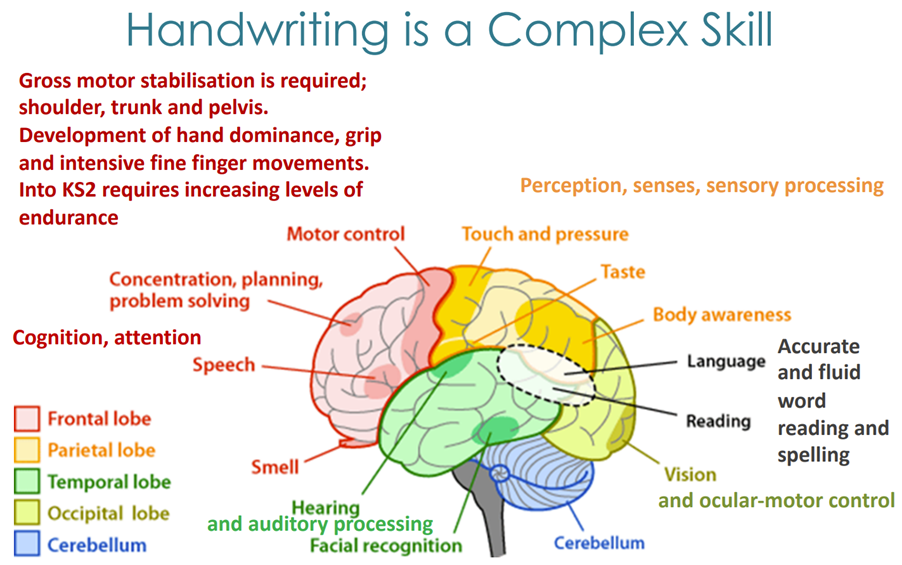
Joined handwriting has been shown to help train the brain to be able to integrate visual and tactile information with fine motor skills (James & Atwood, 2009). It has been shown to activate the motor, visual and linguistic areas of the brain and has a direct relationship with improving maths, spelling and science outcomes in older students.
When studying older students, Mueller and Oppenheimer (2014) showed that taking notes longhand, through writing, improved reading comprehension.
Developing Fine Motor Skills
Fine motor movements are small muscle movements requiring a close eye-hand coordination.
Stick to un-joined letters initially. These are easier to learn as they require fewer strokes and changes in direction.
Introduce learning to join in Year 2 – once the previous outcomes of correct shape, size, and spacing are well established.
Avoid giving joined-up handwriting elevated status in the classroom. Or else some children may feel pressured to try joining before they are ready.
Encourage children who are struggling with the coordination required for joining to focus on improving the legibility and fluency of a basic un-joined style first.
They’re also keen to highlight that writing in a fully joined style can inhibit handwriting fluency. A mixed style has, in fact, been shown to be quicker.
The national curriculum says that joined up handwriting should be the norm by Years 3 and 4. Pupils should be able to use it fast enough to keep pace with what they want to say (Department for Education 2014, p.34). Handwriting should continue to be taught, with the aim of increasing the fluency with which pupils are able to write down what they want to say. This, in turn, will support their composition and spelling (Department for Education 2014, p.39).
As soon as children are able to join letters, they should use this for all of their written work so that it gradually becomes automatic (Education Endowment Foundation 2020, p.38).
Handwriting practice should be extensive, supported by effective feedback and motivational and engaging. A large amount of regular practice is required for pupils to achieve fluency and this can be supported with teachers providing feedback to help pupils focus their effort appropriately.
Ensure the child is ready to write (can they draw kisses correctly?) Encourage lots of large motor and fine motor movements such as climbing and cutting with scissors.*
Teach how to make the letter shapes Use single letters with exit strokes and ensure the child knows which movement group each letter belongs to. Teach by demonstration and observing the children’s practice. Young children can make their letters in sand, paste etc before using pens or pencils.
Teach capital letters and use for names, e.g. Oliver Capitals are as tall as h, l, b etc and do not join to the other letters in a word.*
Write letters on a single line The tails of g, p, etc should hang below the line.
Teach the relative size of letters Give the three sizes names: attic (h, b, etc), room (a, e, etc), cellar (g, y, etc) or sky, grass, underground.
Show how words need a small space between them Please do not use a finger as a spacer – a lolly stick or piece of card is better. *
Teach how to join the letters At this stage omit joining after g, y, j, x, z.*
Encourage writing at increasing speed Introduce loops to y, g, j to increase fluency, and make other individual modifications.
Encourage self evaluation of handwriting using the ‘S’ Factors These are sitting, size, shape, spacing, slant, stringing (i.e. joining) and speed.
* Only proceed beyond the star if the earlier stages have been understood and are used in practice. Stage 6 is probably better addressed in Year 5 or above (age 9/10).
Alongside the above Encourage good habits of posture and pen hold (‘P’ checks). The dynamic tripod is a very efficient way of holding a pen/pencil (pen held between forefinger and thumb with the third finger behind) but it does not suit all children. Comfort and ease of movement are more important.
The way handwriting is taught in school is important. Ensuring there is progression, consistency and persistence in the teaching of handwriting is often a valuable quick win in developing the reading and writing skills of children. The development of pre-handwriting skills in Early Years and Reception is essential. The gross and fine motor skills of children should be developed in a systematic way across the year. Teachers should be aware of how children’s strengths and skills are developing and respond accordingly, but adjusting their provision and planning.
There are many programmes and resources that can be drawn upon to support gross and fine motor control in the early years.
This four- step process for exploring the teaching and learning of spelling in a school can be completed in a couple of hours. It starts with a meeting with subject leaders, finding out about their aims and current concerns, before looking at the school environment and analysing independent writing. Finally, the findings are drawn together and an action plan co-constructed with the school team to develop practice.
At the start, it is important to meet with the subject leaders and explore how the handwriting curriculum is organised and their views on how effective it is. The Subject Leader Review document can be used to structure the conversation.
What age/phase does explicit handwriting teaching start? What pre-handwriting programmes are in place? How does PE and Art feed into the development of children’s gross and fine motor skills?
What schemes/curriculum materials are used?
How often/for how long?
Q2. How is handwriting assessed?
How reliable and valid are the assessments used (if there are any assessments used at all?
How are they used to support children’s learning?
Q3. How do they know? (monitoring)
How frequently is handwriting taught?
Are the children on track with their handwriting skills? Are there explicit expectations of what the children are able to do at the end of each year?
Q4. How does the handwriting curriculum progress in terms of learning from EYs to Yr 6?
Is it sequenced?
Does it follow the NC2014 expectations?
Q5. How do the children’s handwriting skills progress from EYs to Yr 6? Cohorts that are strong? Areas of weak progress/attainment?
What interventions are in place to support children who make slower progress?
Q7. When did staff engage in any professional learning about handwriting?
What did they cover?
What are leaders’ evaluations of the subject/pedagogical content knowledge of teachers regarding handwriting? How do they know?
Q8. Where are the most pressing challenges or areas of concern?
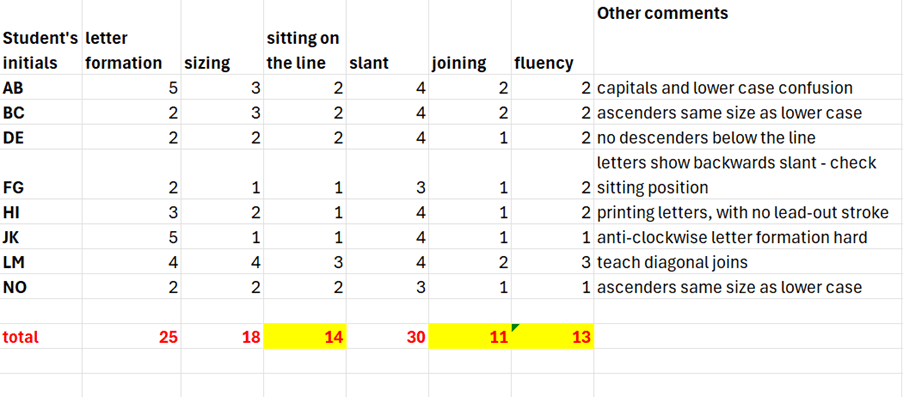
A diagnostic analysis of student handwriting provides both a clear picture of students’ strengths and weaknesses in Handwriting and a clear direction for instruction. The assessment should be an opportunity to evaluate students’ control of letter formation (upper- and lower-case letters), sizing, positioning on the line, joining, spacing and fluency.
Handwriting can be analysed from independent writing the children have produced, or from dictated sentences and short passages that have been designed to include a all letters of the alphabet (.
To get a picture of what children know and have learnt, analysing an independent piece of writing is powerful.
How to analyse the handwriting in an independent writing sample.
Identify a piece of independent writing the children have all written. Ensure there was as little support as possible. If this is not possible, conduct a timed test, where the children are asked to write a sentence as many times as they can in 3 minutes.
Analyse the letter formation and fluency using a scale of 1-5 (1= very poor, 5= excellent). Decide on a score for letter formation, sizing, sitting on the line, slant, joining and fluency.
The analysis of handwriting patterns can lead to a bespoke handwriting catch-up curriculum and help with reviewing the effectiveness and progression of teaching and learning in the curriculum.
Drawing on all the evidence collected, consider the strengths and weaknesses of the teaching and learning in school. The 3 main questions to answer are:
How effective is the curriculum?
How effective is the teaching? How successful are the children at handwriting? Do the majority of the children develop their skills as expected?
How knowledgeable are the staff? Both in the strategies they use to teach and the way they support children to develop their skills.
The answers to these questions will enable an action plan for development to be constructed. There are a range of different approaches and strategies that can be used.
Developing the Curriculum
Considering the progression within the curriculum – is it consistent and develops? Are end of year expectations understood? Refreshing the handwriting policy and planning (ensuring coverage is understood by all) Ensuring appropriate resources are easily available Ensuring pathways for intervention are in place. Cross curricular approaches for developing gross and fine motor skills (PE, playground games and resources, Art and D/T curriculum, and focus on physical development in Eys and KS1)
Developing teaching and learning
Monitoring of teaching Team planning and teaching Handwriting analysis of children’s independent work to inform intervention and catch up teaching at the point of need Regular meetings to share pedagogies and intervention approaches.
Developing subject and pedagogical content knowledge
CPD to develop an understanding of the complexities of handwriting and its development Introduction of different pedagogies Cross-year group observations Team teaching Co – planning following assessment of children Implementing spelling interventions such as Cued-spelling
James, K. H., & Atwood, T. P. (2009). The role of sensorimotor learning in the perception of letter-like forms: Tracking the causes of neural specialization for letters. Cognitive Neuropsychology, 26(1), 91–110. https://doi.org/10.1080/02643290802425914
Santangelo, T., & Graham, S. (2016). A Comprehensive Meta-analysis of Handwriting Instruction. In Educational Psychology Review (Vol. 28, Issue 2). Educational Psychology Review. https://doi.org/10.1007/s10648-015-9335-1
In Part 4, I will be writing about literacy. All, about how children learn to speak, read and write and the pedagogies we know help this process. It is about the research that underpins our knowledge. It is about what we should be doing to ensure all children become literate.
We do know how to teach children. We do know that nearly ALL children (SEND or not) can learn to read and write. Yet, as a society we do not seem to want to make the commitment to ensure that happens.
Yes, it is complicated. Yes, it will cost money. No there is never a simple one-sized fits all solution. But we could do it, if we put aside egos, professional jealousies and profit.
My experience of cancer is like the death of a 1000 cuts. Slowly, piece by piece my disease has robbed me of the ability to do even the most normal of things. I can no longer drive – even if my legs worked well enough, I do not have the concentration or stamina to be safe on the roads. It is months since I have walked the dog or made a meal for my family. In fact, I rarely leave the house. In the 14 months since I was diagnosed with this disease, I have been diminished from a women who was travelling the world, touring schools in the Far East, researching, writing, publishing, training and presenting, to someone who is so fragile they rarely leave the house unless it it to go to the hospital. So, I am reduced to doing what I can do and doing that as well as possible.
There is nothing new in that. I have always been driven to do things as well as I can. Indeed, accepting that, in some cases, done is as good as perfect has taken a lifetime of learning. But the strange contradiction is that sometimes, as well as possible is exactly what is needed and, if a school is in trouble (and I am talking about real difficulties here), then slow and steady perfection can be the best way forward.
In a primary context, I often suggest that we start with handwriting development. Why? Because it is usually easy to get some quick, tangible and obvious results. But more importantly, focusing on this helps lay the groundwork for other more longer-term changes to be adopted. My experience tells me that schools that have stopped developing and are stuck in the need for dramatic improvement have often stopped being places where people work together. A school in trouble is a school where the classroom doors close at the end of the day and the blinds are drawn. Colleagues sequester themselves from one another; heads down, just desperate to get to the end of another working day. Things pile up, get overlooked and forgotten because the day to day becomes overwhelming. So, focusing on just one tangible action can really help.
Handwriting is often a useful first step. It demands colleagues work together, as each year group needs to approach the teaching a little differently. It needs commitment and a willingness to be flexible. It doesn’t really need expensive schemes or materials – there are plenty of free or nearly free materials available. It often benefits from some training, in a collegiate manner and is a positive place to start, in terms of building communities of learners. And, most importantly, if handwriting is done well, it becomes easy to see the improvements – for everyone, children, teachers, parents and leaders. Sweating these small details can be a powerful first step in the long rollercoaster of a school improvement journey.
Part 3 is the section of my blog where I talk about schools and working with schools as a consultant. It is about school improvement, school development, teacher professional learning, leadership development and everything else I can think of.
Of course, I have always been focused on literacy, when working in schools. I believe that literacy is the door into success for schools.
A school in a pickle is often tempted to focus on the managerial aspects of school administration that are obvious and need attention. I have worked with head teachers who have embarked on ambitious building schemes, buried their heads in finance, or HR, or managing the behaviour of a few challenging children -anything else other than what happens in the classroom. They avoid the elephant in the room – the teaching.
Of course, being an excellent classroom practitioner does not mean you know how to develop the skills of teachers who needs to grow professionally. Teaching children and teaching teachers are very different activities and there are many, many headteachers in schools who are not sure how to improve teaching in the classroom – why should they know how to do this? There is no training needed to be a head teacher and much of the training offered to them is about the procedural and legal aspects of running a school. In many respects, headteachers of small schools (primary) are more like administrators than teachers. Yet, a school in a pickle needs to focus on the classroom. So leaders are tempted to bluster through using scripts and tick sheets, grabbing onto the next shiny new resource. They might fill the school with the latest gadgets, sign staff up to ridiculous schemes and fill everyone’s time with meetings to show the staff how to use them. Everyone is busy, all the time, but nothing is ever done. Little gets completed.
So, having a clear focus on one thing – reading, writing and language can be enormously helpful to any school improvement journey. The importance of this area of learning is obvious. A focus on literacy means that we don’t really need to buy schemes, or gadgets. Instead, we need to start with some assessments -we need to know where the children are. Then we look at where the gaps in learning are. Next we learn – we learn about how children learn to read and write. We explore pedagogies that have been proven to be really effective in the classroom and we try them. We come back, we discuss what happened, what we need to do next and off we go again. It is a simple cycle that puts the focus back where it should be – on the children.
This Part 3 of my blog journey is about this process – the process of developing teachers and teachers.
In this final section of this blog, I want to explore ways in which the we can change the education system to ensure we value all of those who work within it. I want to consider how we can make sure everyone who wants to join this profession finds the place where they feel valued and belong.
So how can we do this?
One of the recent phenomena of recent times is the rise of “cognitive science”- the idea that teachers should incorporate the findings from psychological and neuroscientific research about how we learn into their teaching. The limitations of this approach and the misconceptions that have been embedded into policy and practice are for another blog. But one thing that has always surprised me is this interest in what from we can learn psychological research has not really extended further than the classroom, into the realms of effective leadership and how to develop systems that thrive. Perhaps it is because, as the education system has become increasingly market driven, with multi-academy trusts run like businesses, economic value and business practices have become central to the concept of schools. But, how can this be ethically and morally just? Schooling is not a business – we are not buying and selling commodities; children are not data points, or units. Education is about the moral, spiritual, ethical, physical, cognitive, artistic, creative, social and environmental development of every single child in the country. We should be looking towards the research and dialogue that explores these essential characteristics of the education we want for our children.
The psychological research has much to help us with there. Not least, it tells us that the concept of a hero, with ultimate power leading an organisation is outdated and ineffective. In contrast, research, described in the excellent book The New Psychology of Leadership, edited by Haslam, Reicher and Platow , suggests that leaders need to communicate three things:
1. That they are one of us – that they share our values and our concerns and understand our experience;
2. That they are doing it for us – that their efforts are aimed at advancing the good of the group (not themselves);
3. That they are making usmatter – that their actions and achievements are a practical expression of our shared beliefs and values.
Leaders need to show they are working on behalf of the group; listening and learning from, with and on behalf of group to ensure that the group thrives and prospers. The group may lie within a class, a department, in phase or key stage, in a school, or a wider school community such as a MAT. Furthermore, this group may lie at an even broader level; locality, institutional and governmental levels. The work of the psychologist Bronfenbrenner described this ecosystem very well and gives us a clear base to work within.
Haslam, Reicher and Platow recognise that leadership is a social process, with communication at its heart. Rather than striding forward with bombastic, heroic, singular intent (recognise him?), an effective leader recognises that they must promote the interests of the group, helping to craft a sense of identity for the team and its unique position in the world.
Fairness and open transparency really matter. Every voice must be valued and respected. There is strength in diversity and power in acknowledging the differing opinions of others.
This particularly applies when using research and evidence to inform our school development. As we work to influence, the skills of persuasion and cooperation become essential.
Let’s look at an example….
It is well evidenced, for example, that reading aloud across the curriculum is a beneficial way of supporting children to develop wider and deeper vocabulary skills. But this generic pedagogy should look, sound and feel different in every class and every classroom.
A top-down directive issued by a hero and his leadership team instructing staff to follow a scripted model might result in some reading, but it is likely, that it might not continue once the book is finished and no one is watching anymore. An ongoing monitoring process might ensure compliance, but it will not have a lasting influence. Insisting on compliance alone will not change behaviour- teachers will do as they are told (especially if their performance is measured using this metric) and then stop when the instruction is replaced by something else.
In contrast, a careful, collaborative process, where all involved are supported to reflect on the evidence about reading aloud, to understand it and consider how it applies to their own teaching is more likely to lead to longer-term changes in practice. Time spent building understanding, respect, developing motivation and providing regular non-judgmental opportunities to explore the difficult bits ensure everyone learns from and with each other.
Another way that leaders demonstrate value to those they work is through the HR processes they use; appointing colleagues into new roles and awarding pay. It is time that the DFE, unions, representatives of MATs, governors and trustees think hard (openly and transparently) about how job appointments are made and the systems of pay awards they use, including the messages pay scales, pay rises and pay gaps give. This is not just about increasing the pay for teachers, and staff, or ensuring there is an open transparent recruitment process in place (but this is crucial). It is about ensuring that pay is fairly distributed and decisions about pay are fair and justified. We know there is a gender pay gap – women, despite being 97% of the education workforce, typically earn less. And a diversity pay gap. This is obvious at the the senior leader/MAT executive issue. Every year, the top MAT CEO earners are published by the education press. The list is mainly white, middle aged, middle class men (in grey suits)- a obvious lack of diversity and equality. And then consider the amount these CEOs are paid in comparison with other members of staff. This gap is rapidly increasing and there seems to be no attempts to change it. Supporters of the ability to pay enormous salaries claim that these pay packages help to attract and retain high value employees. I do not understand this argument. Schools are communities that rely on everyone within the community working to optimum effect. Within a school, everyone matters. This attitude that there are a group of special heroes who deserve vast salaries, hugely out of line with other employees makes no sense to me.
Or if we look at this from the policy perspective – what Bronfenbrenner would call the macrosystem – then the values and laws that are shared illustrate how leadership is still positioned and valued. The education sector still has a long way to go. I find it illuminating to listen to those who hold national positions of power and influence – CHMI, Children’s Commissioner, MAT CEOs, Regional Schools Commissioners, policy wonks who work for think tanks and charities etc etc. One thing that fascinates me is how they position themselves within a speech or a conversation. More often than not, they refer to themselves in the first person (I spoke to thousands of children; I wrote the report; I held focus groups…. etc) and position themselves as owning the organisation they represent. Hero leadership, lacking in humility, modelled by those who should know better. Of course, if you are the hero, you should take responsibility when it all goes wrong. But, we do not seem to see these heroes accepting this part of the job. How many CEOS step back from their roles at points of financial crisis, or when the majority of their leadership team resign, showing a lack of confidence in their leadership? How many politicians resign when caught in compromising positions? Or headteachers when they are found guilty of seducing students, or education wonks when they are sued? I am not aware of any resignations following the death of Ruth Perry….
Finally, and most importantly, if we are to make the education sector a place where everyone is valued, we need to become comfortable to making decisions that put children at the heart of the conversation. During my career, I have spent a lot of time working in schools that have got in to spots of trouble ( something I will come to in my next blog series). We have to accept that this happens and in many cases, for reasons that are beyond the control of those who work in the schools. However, once this happens, decisions are often made that are not made with the children in mind. A good example is paying consultants, who are considered to be Edu-Celebrities, thousands and thousands of pounds for speeches and presentations should not be happening. Education is a public enterprise, paid for through public money. In my opinion, those working in public service should not be paid more than the prime minister. If budgets are tight, then no school or school community should be paying four figures for a short speech by someone. The child-focused decisions are made at the local level, by teachers, school leaders and communities who understand the unique nature of the challenges.
Making decisions that put children first is a courageous thing to do. It often involves doing things that go against the accepted grain of the general education discourse. But that’s OK. Leadership isn’t about taking charge, or being a hero – it is about getting under the skin of the situation, finding out the detail and communicating effectively with nuance and compassion.
At the heart of this, is the need to create a community that works to ensure all are valued. In the words of Maya Angelou, no one will remember your words, your actions will become distant memories, but they will never forget how you made them feel.
In the first part of this blog series, I shared experiences that had happened to me and colleagues over my career. Undoubtedly, these experiences affected me personally emotionally, psychologically and physically when the stress of it all became too much. It also affected my career opportunities – I know of several occasions when I was denied promotion and further opportunities because of the behaviour of others. If this style of destructive and hostile leadership is common (and I suspect it may be), then this must have a detrimental impact on our schools.
What’s more, most of the situations I described in the first part of this blog series should be classified as workplace bullying or harrassment (this guide by Education Support is helpful in explaining what bullying is and how you can tackle it Bullying and harassment of teachers and education staff)
The impact of bullying and harassment in the workplace is well established. Bullying and harassment makes someone feel anxious and humiliated. Some people may try to retaliate in some way. Others may become frightened and demotivated. Targets of workplace bullying often report low self-esteem, isolation, depression or anxiety. Some find their physical health suffers as they struggle with insomnia or self-medicate with alcohol or recreational drugs. The mental pressure of continued bullying can also manifest in physical symptoms, such as nausea, headaches, high blood pressure, skin rashes or an irritable bowel (Bullying and harassment of teachers and education staff)
Most schools take the bullying of children very seriously- policies are written and complaints addressed. It is not always true that schools are places where all children feel they belong. There are well documented cases of school leaders being clear to parents that their children are not welcome (often because the school down the road does SEND better), and where children are humiliated, as school leaders “flatten the grass”.
But what happens when an entire workforce is bullied? Research highlights that teachers and leaders leave the profession due to excessive workloads, lack of support, relatively low levels of pay in relation to other sectors, and the stress of an extremely high stakes accountability system (New data reveals the scale of the teacher retention crisis | Tes.) To me, it seems entirely possible that the entire sector has been bullied for the past 15 years or so. This was evident during the COVID pandemic. Schools became the focus of support for communities and vulnerable children. I was a headteacher at the time. Of course, in such a time of crisis, the staff team and I were committed to ensure the school supported our community in the best way possible. But as the pandemic continued, this felt increasingly impossible. It is important to remember that for school leaders, the endless rewriting of policy and advice was overwhelming. One minute we were closing the school, the next we were opening, in 48 hours with a huge raft of safety measures to be put in place. Schools budgets were placed under huge strain buying hand sanitizer, PPE and digital equipment – not to mention new digital packages and training to enable staff to deliver online teaching. For a small school, with high levels of pupil premium and children with Special Educational Needs, and key worker parents this meant that around 50% of the children were entitled to be in school. Staff found it incredibly hard to manage in class teaching and digital online teaching at the same time. With high levels of Free School Meals, every day we delivered meals all around the town. We had a duty of care to these vulnerable children and every day, I asked the staff to make sure they saw each child they delivered a meal too. All concerns were recorded and reported. All parents were phoned every week to make sure everything was going OK. We worked incredibly hard to do what we were asked, by the government, to do – that is ensure the community was safe. The staff were amazing in the way they supported and cared for each other. Of course there were moments of tension and fear, but I was incredibly proud to work with such a committed group of people who all pulled together during an incredibly difficult time. I know many school leaders felt the same.
Yet once the pandemic was over and life began to get back to normal, all of this seemed to be forgotten. Standards had dropped and it was the fault of schools for failing to provide a proper education for the children during the pandemic (despite the strenuous efforts we made to do exactly what we were asked to do). It was incredible that academic outcomes suddenly become more valued over and above the physical, emotional and social development of children. All that mattered to national leaders (DFE, Ofsted and those who worked for) was exam outcomes and this, in my opinion, has contributed enormously to the rise in special educational needs. As the children returned to school, we noticed a difference in their gross and fine motor skills – they bumped into things a lot. We put in place extra PE and outdoor play. Handwriting was an issue; social skills and being able to express themselves emotionally was a problem. Speech, language and communication skills were lacking. All of these essential aspects of learning that happen in the primary school had been affected. But no, there was no funding or support for developing these skills. Tutoring in reading, writing and maths, centrally managed and delivered by well meaning, but unqualified people was the way forward, for every school, in every community, regardless. The rest, I imagine, would be provided for by parents and carers – but that is a blog for another time).
Perhaps this could be considered to be another form of systematic, system-level bullying. It is rife in the policy sphere. Policy is made without consideration of the views who do the job – it is societal and organisational bullying by exclusion. Any teacher/leader panels tend to become London-centric; think-tanks, educational charities and policy wonks (often without much practical school experience) occupy the dialogue space. They write glossy reports (claiming to be research studies) that subtly encourage political viewpoints and agendas. If you look at the education press, most articles are written by men, despite the majority of teachers and leaders in every school sphere being female; an unconscious sexism denying the views of most of the population the opportunity to present their perspective. This is not policy making with children at the heart of the decision making and for the teachers and headteachers who come into education to do well by the children, this becomes increasingly hard to manage. Policy is made without any consideration to the views and opinions of the hidden leaders and the experts in their schools who have such a depth of understanding about their community. Psychologists might describe it as experiencing moral injury, causing schools to become psychologically impossible to work in. Education becomes a political football, rather than a serious moral and ethical endeavour. It becomes about the pursuit of power and the abuse of power.
There are many things that are unspoken – they happen and are brushed way, in the interests of reputations and power. Actions always speak louder than words.
I am sitting in a café with a friend, on a wet blustery Sunday morning. The café, located near a popular walking spot is obviously and intimidatingly full of mostly men. Men in tight wet cycling gear; men in dripping trail running shorts and trainers; men in expensive hiking boots and waterproofs. They are jostling arrogantly around to get to the front of the queue, supremely comfortable with themselves, their own sense of importance oozes from every sweaty pore. There is no time or space to for others around. I stand, using my crutch as a shield, feeling vulnerable as they invade the cramped space around the counter. I am acutely aware that it would take very little for one of them to turn and push me over. Finally, I make my way to the front and order a drink. I shuffle back to the seats we have managed to find – we are lucky, important men who are doing exercise do not need to sit down.
She begins to recount the sorry tale of bullying she is facing. A experienced and successful teacher, who runs an outstanding department, known for achieving the highest standards for many years, she has had to face what seems to be systematic and targeted aggression from senior leaders because, in her words, “my face doesn’t fit”. Denied promotion by the leadership, feedback from her interview was relentlessly negative. They have worked to destroy every ounce of confidence, through micromanagement and constant informal conversations in which accusations are alluded to, but never followed up. It was even felt necessary for leadership to conduct a review of her department and observations of lessons, with formal written feedback on the same day that Ofsted (the school inspectorate) were conducting a whole school inspection and could drop in to conduct lesson observations at any point. My response to her question was to suggest she found another job. But even though there is a recruitment and retention crisis in teaching, finding a new job as a Head of Department is difficult unless you have friends in the system. Is it any wonder that teaching is not a desirable profession?
Although I have loved many aspects of my rich and varied career, the sad truth is that, like my friend and many others, I have been at the sharp end of workplace bullying on many occasions. Even before I qualified as a teacher I understood what it meant to be disliked by a senior colleague. In the final placement of my PGCE, a senior teacher, in role as my mentor, was relentlessly unpleasant to me. She took every opportunity to criticize me, especially when other colleagues were around. She downgraded my final teaching practice grades and even took it upon herself to write to the school where I had secured a job to tell the deputy head that I was terrible and would be a disaster in the classroom. Of course, I once I started my first year, I wasn’t terrible – I had never been terrible and had passed all my other teaching observations and teaching practices without any trouble. Once I started as a brand new teacher, in my own classroom, where I could established the routines and practices that suited me and the children, I did fine. I adored my class, worked furiously for them, had positive relationships with the parents and carers and the children made good progress. They were a challenging bunch, who had had six different teachers the year before. The school was climbing out of special measures and I was part of the new regime of young teachers with the energy and determination to give the children the education they deserved. But my confidence as a qualified teacher had been shattered. It took a number of years before I began to believe in my ability as a teacher and to be confident that I could help children to learn, despite the obvious progress the children made.
Sadly, this was not to be the only occasion I experienced unprofessional and vindictive behaviour. Whilst working at a local authority as an advisor, a colleague began to spread unfounded rumours about me, in a targeted and vicious way. Like many who feel this is the way to behave, once I confronted her, she moved onto a different target. However, some of the most serious bullying I face began once I started to become more successful in my career and moved into more senior roles. On three separate occasions, I was targeted by my superiors and subject to petty, nasty and vindictive treatment. During the COVID pandemic, the leader of the school trust I was working for sent a letter of thanks to every single employee, except me (I know, unbelievable, but true). A senior manager at a national charity I was seconded to targeted me with an insidious campaign of belittling and discrimination. He would often tell me that “my knowledge and experience was intimidating”. He felt it would be better if I did not say anything and just did as I was told. Another senior leader consistently took credit for the work I completed, and, when he had finally driven me into the ground, openly shared my confidential health records with colleagues, inside the multi-academy trust and out. He used it to question my competence and belittle me in front of colleagues.
In each case, my response to this behaviour was to attempt to open it up to the cold hard glare of daylight. I carefully composed emails challenging this behaviour, asking why it had happened and requesting that systems and processes in the organisations were thoroughly overhauled to ensure it never happened to anyone else. Of course, I was probably supposed to quietly address my concerns through the appropriate channels, behind the scenes, and slip away with my tail between my legs. I am aware that the networks of power that protect these men, to this day, would simply brush aside my complaints, with some patronising comments about being over sensitive and needing a thicker skin (I am not sure how thick a skin you need to be brush off this extraordinary level of bullying). Equally, I am not sure why I was targeted like this, other than to be good at my job, being prepared to speak out when things were not right and being female. I cannot imagine a man, in a similar position, would ever be told not to share opinions because it was intimidating.
So, why does this matter? Well, the more I have shared my stories of bullying with colleagues across the sector, the more I realise this is very common. One colleague, now a senior MAT executive, was told by her line manager that he did not know what the point of her job was (she was Director of Inclusion, no less). He did not feel she was adding any value to the MAT and he would help her find a new job somewhere else.
Another colleague was asked to step into the role of Acting CEO whilst the substantive CEO was ill. She covered the six month sick leave very successfully, navigating the MAT through a number of challenging situations. Once the substantive CEO returned, she quickly found herself excluded. She was not invited to meetings, important information was not shared and eventually, when she met with HR to find out why, she was told that she was not wanted and should find another position.
In fact, throughout my career, as I worked in schools in spots of difficulty I have heard horror stories that reveal the dark heart of education. Once relationships were build and trust established, the hideous stories came flooding out. The stories of belittlement and humiliation, the ways senior leadership have “managed” teachers out of school, using unachievable targets, overwork and crushing micromanagement. I have heard stories of how staff within the senior leadership team were bought new laptops, with the exception of one person who was the target of the headteacher’s wrath; of unpleasant and criticizing emails being circulated widely. The time when the line manager threatened to destroy an employee’s career unless they did what they were told to do, without question; where promotion was denied on the basis of a personal grudge.
But this is not just confined to school. Everyone has heard the endless stories of poor behaviour by Ofsted Inspectors. Inspectors who put their hands up in the faces of staff who are talking; inspectors who refuse to listen or understand; inspectors, out of their depth and lacking the necessary knowledge and experience resorting to insulting and discriminatory recommendations. Much of this became open, public knowledge following the tragic death of the headteacher, Ruth Perry. The damning report produced by the Coroner, vividly described the part Ofsted and the inspection played in her death. Eventually, after a change of leadership, Ofsted seem to have accepted the findings of the report and have, on the surface, attempted to make changes. But, how much they have done remains to be seen, because this behaviour comes from a deeply embedded toxic culture.
Right at the top, the bullying continues. The approach taken by Michael Gove, Nick Gibb and other ministers towards schools and their staff has legitimised bullying across the system, in my opinion. Social media launched the careers of many edu-celebrities; those who were in the right place, at the right time, with the willingness to do pretty much anything in order to become important (and rich). Online, these bloggers attacked anyone they felt got in their way. They targeted those who did not agree with their views and practices, hunting in packs to do what they could to discredit anyone in their way. They were, and continue to be, petty, thin-skinned, vicious and small-minded. They were, and continue to be, supported (and in some cases, handsomely paid) by the Department of Education.
So there it is. There is strong evidence that education is a sector that hides a dirty secret. It is a community that celebrates leaders who are perceived as decisive and tough – but who are, in reality, not able to do anything of value without excluding, belittling and bullying. Is it any wonder that we have a recruitment and retention crisis?
In Part 2ii, I am going to try and get to the heart of this issue by exploring what the research and my experience suggest we might be able to do to alter this hideous situation. I want to think bout how we might be able to become an education community that internationally respected for the care and consideration that all members of the community are afforded and teaching becomes a profession we can be proud of.
 Megan Jane Dixon: teacher, Researcher, Leader